Dive into the ultimate guide to cat facts, from their DNA to their superhero senses to the secret psychology behind everything they do. Find out why your cat really runs the house.
These creatures look like they were engineered by a sci-fi designer. We look at them and see a pet, but scratch the surface (carefully, unless you want a swipe), and you’ll find a universe of evolutionary adaptations that border on impossible.
Like I mentioned before, I live with them, and every day is a lesson in humility. They’re masters of stoicism and, at the same time, the most playful beings on earth. We’re going to break this deep dive into sections, covering every part of their lives that makes them one of a kind. Buckle up, because we’re going way beyond the basics.
This post may contain affiliate links. If you buy through them, you support my work at no extra cost to you.
Cat Facts at a Glance
| Category | The Secret | Why It’s Wild |
| Genetics | 95.6% Tiger DNA | Your cat isn’t a stuffed animal. It’s a small, self-domesticated apex predator with every instinct still intact. |
| Anatomy | “Liquid” Skeleton | No rigid collarbone, 53 vertebrae. If the head fits, the rest follows. |
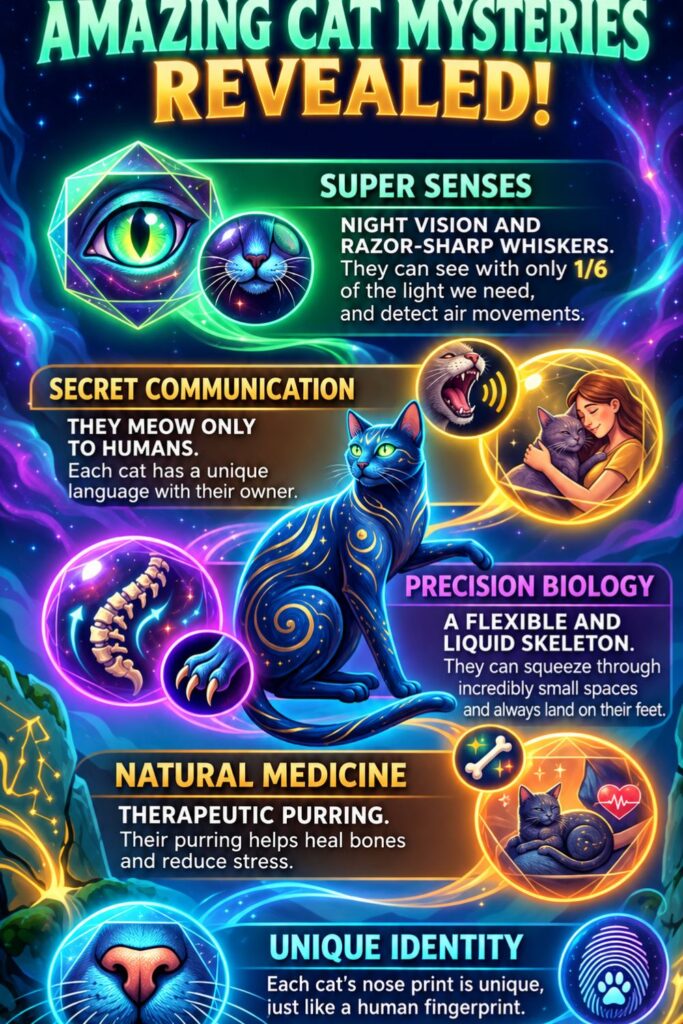
| Senses | Whiskers (Vibrissae) | Tactical radar that detects air currents and measures gaps in total darkness. |
| Communication | The Social Meow | Adult cats only meow to talk to humans. It’s a language they invented just for us. |
| Health | Healing Purr | Vibrates between 25 and 150 Hz, a frequency range that promotes bone healing, tissue repair, and lowers your stress. |
| Grooming | Sandpaper Tongue | Their keratin barbs double as a comb, a hunting tool, and a cooling system. |
| Identity | Unique Nose Print | The pattern on a cat’s nose is like a human fingerprint. No two are alike. |
| Rest | 70% of Life Asleep | Not laziness. Extreme energy conservation so they’re always ready to strike (or launch midnight zoomies). |
| Psychology | Face Rubbing | When they rub against you, they’re tagging you as part of their safe territory and family. |
| Diet | Zero Sweet Tooth | The only mammals that can’t taste sweetness, thanks to a genetic mutation. |

1. Biological Engineering: A Design 10 Million Years in the Making
A cat is a precision machine. Its bone and muscle structure is a masterpiece that’s barely changed since its desert-dwelling ancestors.
The “Liquid” Skeleton: How They Fit Into Impossible Spaces
You’ve definitely seen your cat squeeze into a shoebox that looks three sizes too small. It’s not magic; it’s anatomy. Cats don’t have a rigid collarbone like we do. Their shoulder blades are connected to the rest of the body by muscles, not bone. That lets them compress their rib cage and slide through any opening their head can fit through.
Their spine is ridiculously flexible, too. They have 53 vertebrae (we only have 33), giving them an almost full range of rotation. They can arch their back in a 180-degree curve. That flexibility isn’t just for sleeping in weird positions; it’s what fuels the explosive acceleration they use when they hunt.
Retractable Claws: A Weapon That’s Always Sharp
Unlike dogs, whose nails wear down from walking, cats keep theirs tucked inside sheaths of skin. That way, when they need them, the claws come out factory-sharp. Here’s a detail most people don’t know: cats are digitigrades, meaning they walk on the tips of their toes. Imagine spending your entire life on tiptoe with flawless agility. That’s what makes them so eerily silent.
The Tongue: Keratin Barbs
If a cat has ever licked you, you know it feels like sandpaper. Those tiny “spines” are called filiform papillae, and they’re made of keratin, the same stuff as our fingernails. They serve multiple purposes: they work as a comb for grooming, they help strip meat from bone when eating prey, and here’s the really cool part, they’re hook-shaped and can trap saliva, which evaporates and helps cool the cat’s skin in summer.
2. Senses From the Future: Living in Another Dimension
What you and I perceive of the world is just a fraction of what a cat picks up. They’re living in augmented reality around the clock.
Night Vision: The Tapetum Lucidum
Ever noticed how cats’ eyes glow in the dark when light hits them? That’s the tapetum lucidum, a layer of tissue behind the retina that acts like a mirror. It bounces light back to the photoreceptors, letting them see with about one-sixth the light we’d need.
There’s a myth worth busting here, though: cats can’t see in total darkness. They still need at least a sliver of ambient light. Their color vision is also limited. They see blues and greens well, but reds and pinks are mostly lost on them. They’re basically functionally color-blind, but they make up for it with motion detection that would put a military radar to shame.
Jacobson’s Organ: Tasting Smells
Have you ever seen your cat freeze with its mouth hanging half open and a kind of goofy expression after sniffing something strong? That’s called the “Flehmen response.” They’re using the vomeronasal organ, also known as Jacobson’s organ, located on the roof of the mouth. By opening their mouth, they pump air toward that organ to chemically analyze pheromones and complex scents. They’re literally tasting the information in the air.
Balance: The Vestibular System
A cat’s inner ear is an engineering marvel. It contains fluid-filled canals and tiny crystals that tell the brain the exact position of the head relative to the ground at all times. That’s why, even when they fall on their back, the brain processes the data in milliseconds and tells the body to rotate. The head turns first, then the front legs, then the back legs.
3. Cat Psychology: Decoding a Complex Mind
This is where most people get it wrong. Cats are often called aloof or selfish, but that couldn’t be further from the truth. They’re just not dogs. Their social system works differently.
The Scent Hierarchy
For a cat, scent is identity. When your cat rubs against your legs as you walk in the door, it’s not just saying hi. It’s using glands on its cheeks and at the base of its tail to mark you. It’s putting its ownership tag on you. At the same time, it’s checking where you’ve been. It’s a constant exchange of information. If you shower and wash that scent off, the cat will feel the need to mark you all over again so you “belong to the family” once more.
The Stress of Change
Cats are neophobic: they fear the unfamiliar. Their sense of security depends on their territory being predictable. A new piece of furniture, an unexpected visitor, even switching litter brands can spike their cortisol levels. So when people say cats are “particular,” what’s really going on is that they’re fiercely protective of their own peace of mind.
Why Do They Love Boxes So Much?
A study at Utrecht University found that boxes significantly reduce stress in shelter cats. The reason is simple: a box is a safe spot where no predator can sneak up from behind. On top of that, cardboard is an excellent insulator. A cat’s ideal temperature range is between 86 and 97°F (30-36°C), way higher than ours. That’s why they’re always seeking out the cardboard box, the radiator, or your warm laptop.
4. Social Behavior: More Going On Than You Think
We think of them as loners, but cats actually have a rich social life full of nuance that we tend to overlook.
Colonies and the Matriarchy
In the wild, cats tend to form colonies made up mostly of related females. They raise kittens as a group. Males are usually more nomadic. This explains why female cats tend to be more territorial and protective of the home, while neutered males are often more laid-back and playful.
Play: Training for the Kill
When you see your cat chasing a feather or a laser dot, it’s not just “having fun” the way we’d think of it. It’s rehearsing its hunting sequence: spot, stalk, pounce, deliver the final blow. The problem with laser pointers is that there’s never a physical “catch” at the end, which can lead to frustration. That’s why I always recommend ending a play session with a toy they can actually bite or a treat.
What the Tail Is Telling You: An Emotional Traffic Light
The tail is the most honest indicator of a cat’s mood:
- Straight up with a curved tip: happy and saying hello.
- Puffed up like a bottle brush: scared or seriously ticked off.
- Whipping side to side: not happy. A clear warning: “Back off, or there will be consequences.”
- Wrapped around your legs: a cat hug.
5. Myths vs. Reality: Setting the Record Straight
Throughout history, cats have been worshiped as gods and hunted as demons. That’s left behind a trail of myths that need clearing up.
The Milk Myth
Movies love showing cats lapping milk from a saucer. The reality? Most adult cats are lactose intolerant. Once they’re past the kitten stage, they stop producing the enzyme needed to digest cow’s milk, which leads to serious digestive issues. Fresh water is always the way to go.
Black Cats and Bad Luck
In many countries, black cats have been unfairly tied to witchcraft and superstition. In Scotland and Japan, though, a black cat on your doorstep is a symbol of prosperity and good fortune. Genetically, black coats tend to be linked to stronger immune systems. So bad luck? Hardly. They’re basically supercats.
6. The Human-Cat Bond: Way More Than Just a Pet
Science has shown that having a cat improves your mental health. Simply petting a cat releases oxytocin, the love and well-being hormone.
Purring as Frequency Therapy
Back to the purr: veterinarians have noticed that cats heal from bone fractures much faster than other animals. The theory is that the mechanical vibration of purring stimulates cell regeneration. There’s even research suggesting this frequency could help prevent osteoporosis in humans who live with cats. Your cat is basically a vibrational therapist.
Do They Actually Understand Us?
Recent studies in Japan confirmed that cats recognize their own name perfectly well, even when a stranger says it. The catch? They choose to ignore us. Unlike dogs, who are wired to please, a cat evaluates whether the interaction benefits them in that moment. It’s pure emotional honesty.
7. Tips for Living Your Best Life Together
If you want a truly happy cat, you need to think like one. Food and cuddles aren’t enough.
Height Matters
A cat on the floor is a vulnerable cat. A cat on top of a bookshelf is king of the world. Giving them “cat highways” (cleared shelves or cat trees) is essential for their emotional balance. It lets them survey their territory from a position of power.
The Bathroom Rule
Nobody wants to eat in the bathroom, right? Cats feel the same way. Their litter box should be as far from their food and water as possible. Cats also prefer running water. In the wild, standing water is usually contaminated. That’s why so many cats would rather drink from the faucet or a fountain than from their bowl.
Frequently Asked Questions About Cat Facts
Why does my cat bite when I rub its belly?
The belly is a cat’s most vulnerable spot. Rolling over and showing it is a sign of trust, but it doesn’t always mean “please pet me here.” For a lot of cats, that touch triggers a defensive reflex. It’s basically them saying: “I trust you enough to show you my weak spot, but don’t push it.”
Is it bad to let my cat sleep with me?
Not at all! If you don’t mind sharing half your pillow, it’s actually wonderful. For your cat, sleeping next to you is the ultimate sign that you belong to the same social group. Plus, your body heat helps them maintain their temperature without any effort.
Why do they sometimes stare at nothing?
Like we talked about, their senses are way sharper than ours. It could be a speck of dust lit up by a sunbeam you can’t see, a tiny bug, or a distant sound. Don’t worry, ghosts are probably not involved (or so we like to think).
Do cats really need to eat grass?
Yes, it’s instinctive. Grass helps them purge their digestive system, especially to get rid of hairballs they swallow during grooming. If they don’t have cat grass available, they’ll go after your houseplants (and some of those can be toxic), so you’re better off getting them a cat grass growing kit.
Can I actually train my cat?
Absolutely. Cats are smart and can learn tricks (sit, shake, come when called) using positive reinforcement. The key is keeping sessions short and making sure the reward (wet food or treats) is something they really want.
The Mystery Continues
I could keep going and we’d still be uncovering amazing details. Cats aren’t just animals that live in our houses. They’re a window into a wild world we’ve somehow managed to fold into our daily routine. Understanding what makes them tick doesn’t just make us better owners; it helps us appreciate the incredible diversity of life on this planet.
Every cat is an individual with its own personality, its own quirks, and its own way of showing love. Don’t try to make it a dog. Enjoy the independence, and treasure those moments when it chooses, completely on its own terms, to curl up next to you.
Now I want to hear from you: out of everything we’ve covered, what surprised you the most? Does your cat do something you can’t explain? Drop a comment below and let’s talk about it. I love reading your stories and learning about your furballs.
See you in the comments!