
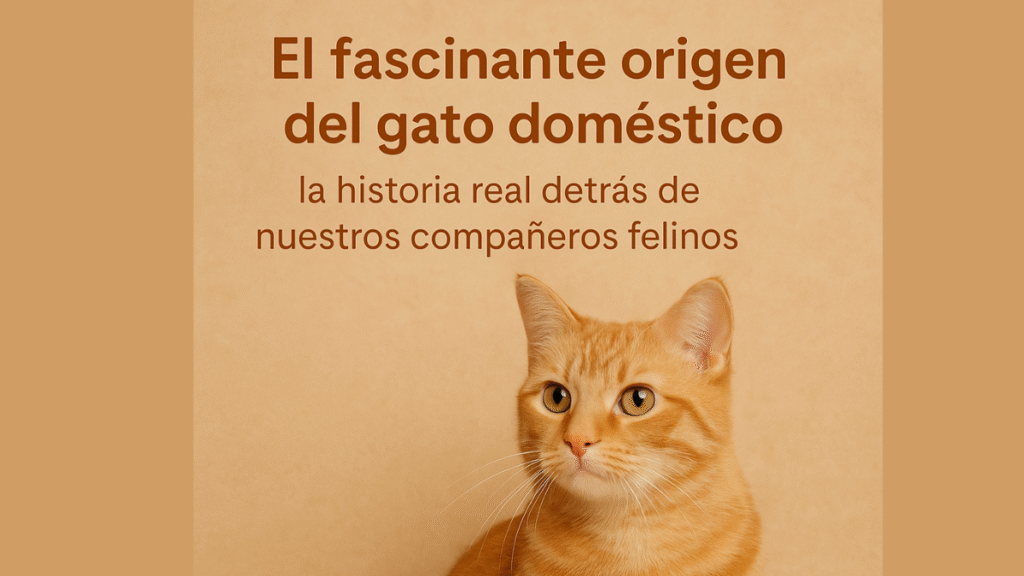
Discover the origin of the domestic cat: from wild hunter to couch companion. A true story full of fun facts, evolution, and feline love.
There’s something about cats that pulls you in. That mix of mystery and tenderness, independence and carefully measured affection. People say nobody really owns a cat, that they’re the ones who choose us. To be honest, the more time goes by, the more I believe it.
Let’s talk about where cats actually come from, and how they went from being tiny desert predators to sleeping peacefully on our blankets. Because yes, that little furball curled up in your house right now has ancestors that were hunting mice thousands of years ago in the sands of the Middle East.
“With plenty of style, too,” Minursi reminds me from the couch, licking his paw with an air of superiority.
Before the Purr: The World’s First Cats
Picture the world about ten thousand years ago. Humans were just starting to settle down, learning to farm and store grain. With that came the first enemies of all that hard work: mice. Where there are mice, there are cats.
Experts believe the domestic cat descends from the African wildcat (Felis silvestris lybica), a solitary, agile, and silent feline that lived in the arid regions of North Africa and the Middle East. This cat didn’t need humans to survive, but it figured out that human settlements were basically an all-you-can-eat rodent buffet.
They approached slowly, in no rush, just watching. Humans, for their part, realized these hunters were useful. That’s how a relationship started that was, at first, more about convenience than love.
The First Time Humans and Cats Lived Together
Unlike dogs, which were domesticated through selective breeding over centuries to help with hunting or protection, cats pretty much domesticated themselves. No human sat down and said “I’m going to domesticate a cat.” The cats decided to stick around on their own.
That might be one of the most fascinating things about their history: cats domesticated themselves.
When humans began living in farming communities in what’s known as the Fertile Crescent (a region spanning Egypt, Syria, Israel, Iraq, and parts of Iran), they also started storing grain. That attracted mice, which in turn attracted wild cats.
The calmer, less aggressive cats that could tolerate being around people were the ones that thrived. Little by little, generation after generation, they became more social and started forming bonds with humans.
In exchange for their talent at catching mice, they got food, shelter, and protection. That’s how the first form of coexistence between humans and cats was born. Thousands of years later, most cats still do whatever they want, but that unspoken deal is still going strong: they protect us from chaos (in their own way), and we adore them.
Cats and Ancient Egypt: A Love Story
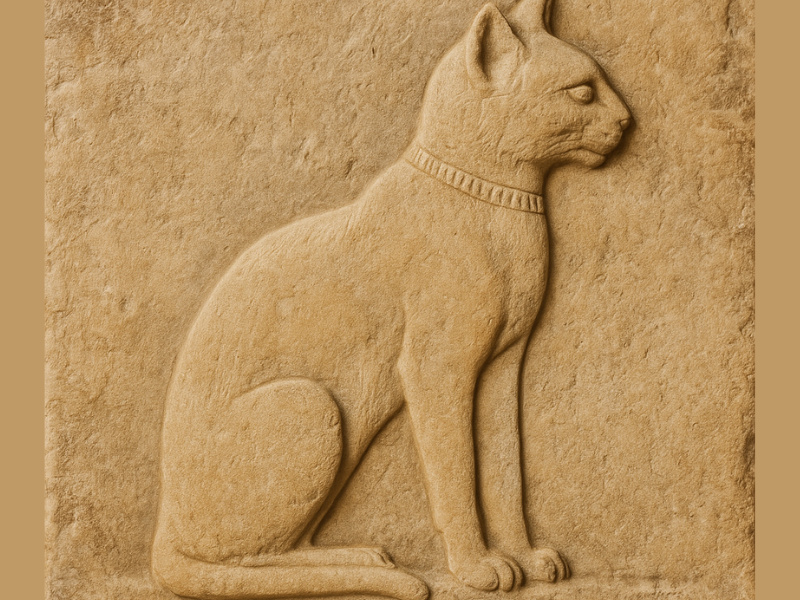
If there’s one place where cats reached the status of gods, it was ancient Egypt. The Egyptians didn’t just admire them; they considered them sacred. The cat, or mau, was a symbol of elegance, protection, and fertility. Having one in the house was considered good luck.
The Egyptians’ love for cats ran so deep that they even had a cat-shaped goddess: Bastet, protector of the home, family, and childbirth. Temples dedicated to Bastet held thousands of cat statues and figurines. When a cat died, the family would mummify it and store it in special urns. In some cases, they’d even shave their eyebrows as a sign of mourning.
“Now that’s what I call respect, human,” says Minursi, clearly pleased with this part of the story.
Respect is an understatement. The Egyptians even passed laws that punished anyone who harmed a cat with death, even if it was an accident.
Archaeologists have found entire cemeteries with thousands of mummified cats. Some even had collars and amulets, which gives you a pretty good idea of how important they were in that society.
The most interesting part is that the Egyptians were the ones who spread cats around the world, carrying them on ships to control pests in grain shipments. Without realizing it, they were helping cats take over the planet.
From the Nile to the World: Cats on the Move
Over time, cats spread well beyond Egypt. The Phoenicians and Romans brought them aboard their ships, where they were essential for keeping rats under control. That’s how cats made it to Europe, Asia, and centuries later, the Americas. Their reputation as efficient hunters and their natural elegance meant every culture put its own spin on them.
In Rome, they were associated with freedom. In Greece, they symbolized independence. In Japan, they’re tied to good luck.
Everywhere they landed, they found a place in people’s homes.
A Relationship That Wasn’t Always Easy
We may love cats now, but that hasn’t always been the case. During the Middle Ages, especially in Europe, cats were unfairly persecuted.
They were linked to witchcraft, bad luck, and the supernatural. Many were killed alongside women accused of being witches, and for centuries, their population dropped dramatically.
Ironically, their absence helped rats thrive, and with the rats came the plague. Only when things got completely out of hand did people start recognizing cats again as natural pest control.
Minursi usually looks horrified when I tell him this part.
“I don’t understand how you survived without us, human,” he says.
Honestly, neither do I.
The Cat’s Triumphant Return to European Homes
After centuries of superstition and fear, cats gradually won people over again. During the Renaissance, attitudes started to shift. Science was waking up, religious ideas were loosening their grip, and humans began looking at animals differently.
Cats quietly made their way back into homes, warehouses, and farms. They were allies against rats once more, but people were also starting to see them as companions.
They showed up in paintings, poems, and the letters of influential figures. Leonardo da Vinci, for example, sketched them with real tenderness. Isaac Newton is credited with inventing the cat flap so his cat could come and go without bothering him. Slowly but surely, the bad reputation faded.
“About time,” says Minursi with a yawn. “You made us wait way too long to be treated the way we deserve.“
He’s not wrong. Cats didn’t just return to people’s homes; they found their way back into art, literature, and hearts.
Cats in Other Cultures: A Journey of Many Lives
While cats had a rough ride in Europe, other parts of the world have always treated them as something special. In Asia, for example, they’ve been tied to luck, protection, and spirituality for centuries.
Japan: The Lucky Cat
You’ve probably seen the Maneki-neko at some point, that little cat figure with one paw raised, waving at you from a store window. It’s Japan’s famous “lucky cat.”
Legend has it that a cat once saved a samurai from being struck by lightning, and ever since, cats have been associated with good fortune. That’s why the Maneki-neko has become such a popular good-luck charm.
In Japanese culture, cats represent balance and calm. There are even temples dedicated to them, like the famous Gotokuji in Tokyo, covered in little white cat figurines with their paws raised.
“I could have my own temple too, right?” says Minursi with fake modesty.
Honestly, I wouldn’t rule it out.
China: Guardians of the Fields and the Night
In ancient China, cats were protectors of crops and homes. People believed their gaze could scare away evil spirits and guard the grain from mice. They were also linked to the moon, femininity, and introspection. In Chinese poetry, they appear as quiet creatures watching time go by.
The cat’s elegance and calm fit perfectly with Taoist philosophy: move without effort, live in harmony, don’t force things. When you think about it, cats are basically Taoism in motion.
The Middle East: Between the Sacred and the Everyday
In the Islamic world, cats hold a special place too. They’re considered clean and respected animals. According to tradition, the Prophet Muhammad had a cat named Muezza that he loved so much he once chose to cut the sleeve of his robe rather than wake the cat sleeping on it.
That’s why cats are welcome in homes and mosques across many Muslim countries. Medieval European travelers were surprised to see how freely cats roamed and how well they were cared for. It’s no coincidence that in many old North African cities you can still see cats strolling calmly among the people. They’re part of the scenery, as if time never passed.
The Modern Domestication of the Cat
Even though the bond between humans and cats goes back thousands of years, modern domestication is relatively recent. For centuries, cats lived somewhere between independence and coexistence. It wasn’t until the 1800s, with the rise of cat shows and selective breeding, that they started being seen as pets in the way we think of them today.
From Hunters to Couch Companions
The first documented cat show was held in London in 1871. From that point on, the first recognized breeds and feline beauty standards began to emerge. Cats became symbols of elegance, sophistication, and quiet companionship.
Around that time, writers like Edgar Allan Poe and Mark Twain spoke about them with devotion. Poe called the cat “the embodiment of the mysterious soul.” Twain said that if you could cross a man with a cat, it would improve the man but ruin the cat.
Minursi nods quietly. “I completely agree with that Twain guy.“
Over time, cats went from being barn guardians to full-fledged family members. Today, they’re woven into our routines, our photos, our memes, and most importantly, our daily affection.
Cats in Science and Genetics: A Lineage Thousands of Years Old
The latest genetic studies confirm that every domestic cat alive today descends from the African wildcat, the same one that prowled grain fields about 10,000 years ago.
DNA That’s Barely Changed
The most surprising part is that domestic cat DNA has changed very little compared to their wild ancestors. That tells us their domestication was far less intense than it was for other animals like dogs or cattle. In other words, today’s cats are still essentially the same solitary desert hunters; they’ve just learned to appreciate couches and radiators.
Their instincts, behavior, and body structure remain nearly identical to those of their ancestors. So when your cat chases shadows, hides in boxes, or ambushes your feet under the blanket, those aren’t quirks. They’re echoes of thousands of years of evolution.
“Exactly,” says Minursi. “I hunt socks to keep my skills at peak level.“
I can’t help but laugh. Because he’s right.
Cats Go Global
Today, cats live in nearly every corner of the planet. From the temples of Thailand to apartments in Madrid, from the cafés of Istanbul to entire islands where they’ve become local celebrities.
Their ability to adapt is incredible. They can thrive in hot or cold climates, in small towns or big cities. All they need are three things: food, shelter, and a human to adopt.
Cats in Art, Culture, and the Human Soul
Throughout history, cats have shown up in art and literature. Not just as pets, but as symbols of freedom, mystery, and power.
From Egyptian hieroglyphics to Renoir’s paintings, from Baudelaire’s poetry to Haruki Murakami’s novels, cats have always represented something deeper: that blend of wild and tender that fascinates us. Even now, in the middle of the digital age, they keep inspiring countless artworks, memes, photographs, and entire online communities. Cats are, without question, the true rulers of the internet.
“Well, we already knew that,” says Minursi, stretching with a look of satisfaction.
Cats in Modern Society: From Instinct to Emotional Connection
Today, thousands of years after that first wild cat wandered into a village looking for mice, cats are an inseparable part of our lives. They’ve gone from solitary hunters to roommates, silent confidants, and in many cases, four-legged therapists.
The funny thing is, they’re still the same as they’ve always been. Their hunting instincts, their need for independence, their elegance, and their watchful nature are all still intact. They’ve just learned to live with us. Or, more accurately, we’ve learned to live with them.
“Finally you admit it,” says Minursi from his blanket, with a little feline half-smile.
How Our Relationship with Cats Changed
For most of the 20th century, cats were still seen as somewhat distant animals. But modern life changed everything: cities, small apartments, endless work hours. Cats became the ideal companion: clean, calm, and perfectly happy in tight spaces.
Gradually, the way we saw them shifted. They weren’t just house pets anymore; they were family. Today, many have names, toys, a trusted vet, and even Instagram accounts.
Some might say we’ve humanized cats too much, but I think what we’ve really done is recognize what they always were: sensitive, intelligent beings capable of forming real bonds.
Cats and Wellness: A Deep Connection
More and more studies confirm what cat lovers have always known: living with a cat reduces stress, anxiety, and loneliness.
The simple sound of a purr can have a calming effect on your body. Research has shown that purring vibrations can even help regulate blood pressure and promote relaxation.
“Obviously. That’s my superpower,” says Minursi, giving me his best zen-cat look.
Honestly, I can’t argue with that.
Having a cat around teaches you to be present, to enjoy the silence, to notice the small things. It’s a reminder that you don’t need to do anything grand to feel at peace.
Cats and the Future: A Relationship That Keeps Evolving
We’re living in a strange moment. On one hand, there are more domestic cats in the world than ever. On the other, millions are still without a home.
Awareness around animal welfare has grown a lot in recent years. More people are adopting, spaying and neutering, and caring for their cats with real knowledge and responsibility. But there’s still a long way to go.
Cats are animals with specific needs: they need stimulation, play, rest, safety, and affection. It’s not enough to just have one; you need to understand them. Even though Minursi can’t talk, he teaches me something new every day about what it means to coexist with respect.
“Exactly, human. It’s not about taming us. It’s about living together with wisdom.“
If cats wrote books, that line would be on the first page.
What Cats Teach Us About Ourselves
Living with a cat is, at its core, like holding up a mirror. It shows you your patience, your need for control, your ability to accept someone else’s rhythm.
Cats don’t rush. They don’t live by the clock. They don’t expect anything, and yet, they have everything. I think that’s what inspires me most about them.
Every time I watch Minursi sleeping peacefully, I feel like he’s teaching me something words can’t capture: the importance of just being present, without noise, without pretense. Maybe that’s why, after all these thousands of years, we’re still fascinated by cats. Because somehow, they remind us of something we’ve forgotten.
Frequently Asked Questions About the Origin of the Domestic Cat
What animal does the domestic cat descend from?
The African wildcat (Felis silvestris lybica). This small feline lived in the arid regions of North Africa and the Middle East and was drawn to humans by the mice that invaded their grain stores.
Where were cats first domesticated?
In the Fertile Crescent, a region that covers parts of Egypt, Israel, Syria, Iraq, and Iran. That’s where agriculture was born, and with it, the coexistence between cats and humans.
Why did cats domesticate themselves?
Because they didn’t need to be forced. They came to human settlements on their own, drawn by the food. The calmer, more tolerant cats thrived, leading to a relationship of mutual benefit.
How did cats spread around the world?
The Egyptians and Phoenicians carried them on ships to control rats in their cargo. That’s how they spread across the Mediterranean, Europe, and Asia.
What traits do they still share with their ancestors?
Nearly all of them: their hunting instincts, territorial behavior, nocturnal habits, and independence. Even if they live in an apartment, they’re still tiny predators at heart.
From the Desert to Our Hearts
When you think about it, the domestic cat’s journey is an amazing story. A small, solitary hunter who, without even trying, ended up conquering the world. Not through force or submission, but with elegance, patience, and a quiet presence.
Thousands of years later, here we are. You, me, and Minursi.
They’re still the same as ever: observant, curious, mysterious. We keep falling for the way they look at us, like they know something we’ve forgotten.
If you made it this far, thank you for reading a story that started thousands of years ago in a corner of the desert, and that’s still alive today in every home where a cat stretches out in the sun.
Tell me: did you know your cat has African ancestors? Can you picture their great-great-grandparent hunting through the sands along the Nile? I’d love to know if you feel that connection to the ancient history of cats too. Leave your thoughts in the comments. The next time your cat looks at you with that wise, ancient expression, remember: you’re not just looking at your pet. You’re looking at the living history of thousands of years of coexistence.

