
Discover the fascinating world of cat purring: how it works, why they do it, what science tells us, and what emotions are hiding behind the sound that calms and connects.
Some sounds stay with you without making a fuss. A cat’s purr is one of them.
When Minursi curls up next to me, eyes half-closed and that soft hum vibrating through his chest, the world pauses for a second. It’s one of those things that makes you think cats know something we forgot a long time ago. Over the years, scientists, vets, and cat lovers have all tried to crack the mystery of purring. Why do they do it? How do they keep that sound going so steadily? Is it just pleasure, or is there something deeper, maybe even therapeutic?
Science has come a long way, but purring is still partly an enigma. What makes it so fascinating is that it blends biology, emotion, and something that feels almost spiritual. That, as you’ll see, only makes it more magical.
How Cat Purring Actually Works
I always thought purring was almost magical, like cats had a tiny secret engine tucked inside their throat. The real explanation, though, is way more interesting.
For years, people believed the sound came from the heart, blood flow, or even some kind of vibration in the chest. Today, we know that purring is produced by the muscles of the larynx. These muscles contract rhythmically, between 25 and 150 times per second. As the cat inhales and exhales, this movement opens and closes the glottis, which causes the air to vibrate as it passes through. The result is that low, continuous, unmistakable hum we all love.
The most amazing part is that cats can purr on both the inhale and the exhale, keeping it going effortlessly for minutes or even hours.
Sometimes when Minursi purrs, I notice his rhythm syncing up with my breathing. It pulls you in without you realizing it, like his body and yours quietly agreed to slow down together.
Not All Felines Purr the Same Way
Even though we tend to associate purring with domestic cats, not all felines do it. Big cats like lions and tigers can’t purr continuously; they only produce a similar sound when they exhale. This comes down to anatomy: the structure of their hyoid bone (the one connecting the tongue to the larynx) is more flexible in larger felines.
That’s why experts split felines into two groups:
- True purrers (like domestic cats, ocelots, cougars, and servals).
- Those that would rather roar than purr (like lions and tigers).
So yes, Minursi belongs to the exclusive club that chooses purring over roaring. Although, when a bird flies past the window, the line between the two gets pretty thin.
Purring from Birth: A Language That Starts Early
The sweetest part of all this is that cats learn to purr very early on. Kittens start doing it when they’re just a few days old, even before their eyes open.
That first purr isn’t about pleasure. It’s a way of communicating with their mother. It’s their way of saying “I’m okay, I’m here, I’m hungry.” The mother purrs back, as if to answer “Relax, I hear you.”
It’s a silent conversation full of meaning, and probably the first emotional language cats share. When I see Minursi asleep and hear him purring in his dreams, I sometimes wonder if, on some level, he’s still reaching back to that feeling of safety he had as a kitten. Like a quiet echo of the bond with his mother.
Why Do Adult Cats Purr?
For a long time, people assumed cats only purred when they were happy. The reality is a lot more complex. Science has shown that cats purr in all kinds of situations:
- When they’re relaxed or enjoying being petted.
- When they’re hungry and looking for attention.
- When they’re scared or injured.
- Even in the moments before death.
Yes, they purr through pain too. Far from being sad, it’s an incredible example of how this sound serves physical and emotional functions that go well beyond simple pleasure.
Purring as Emotional Self-Regulation
Many ethologists (animal behavior experts) believe cats purr as a form of emotional self-regulation.
In stressful situations, purring releases endorphins and helps the cat calm down. It’s as if their own body offers them a built-in comfort mechanism.
When Minursi goes to the vet, for example, he sometimes purrs. Not because he’s happy (he clearly isn’t), but because he’s trying to soothe himself. That purr sounds different: faster, more irregular. Those subtle differences are where we humans learn to listen better.
Healing Frequencies: Cat Purring as Natural Therapy
This is one of the most fascinating aspects. Studies have shown that the vibrations of a purr (between 25 and 50 Hz) can actually have healing effects.
In cats, these frequencies help regenerate tissue, reduce pain, and strengthen bones. Cats that purr frequently have been observed to recover faster from fractures and injuries. But here’s where it gets really interesting: those same frequencies have positive effects on humans too. Multiple studies suggest that listening to a cat purr can:
- Lower blood pressure.
- Reduce anxiety and stress.
- Stimulate serotonin production (often called the “happiness hormone”).
- Improve focus and rest.
That doesn’t surprise me. When I’ve had a rough day and Minursi hops on the couch and starts purring, I can feel everything shift. The sound slips in between your thoughts and quiets them down without any effort.
What Science Says About the Vibration
Professor Elizabeth von Muggenthaler, a specialist in bioacoustics, was one of the first to measure the exact frequencies of purring and link them to healing processes. She found that cats purr in the ideal frequency range to promote muscle and bone recovery.
Sound engineers have also analyzed the spectrum. It’s not a single pure tone but a harmonic blend that shifts slightly with each breath. That might be why it’s so hypnotic: it’s not a constant noise but a living pulse.
NASA even studied similar vibrations to help maintain bone health in astronauts in zero gravity. Who would’ve thought cats had something in common with space travel?
Purring, Bonding, and Shared Energy
There’s something deeply meaningful about the moment a cat purrs next to you. It’s not just a sound: it’s a vibration that wraps around you and pulls you in.
Neuroscience explains it through emotional contagion. When a cat purrs, our brain reads those vibrations as signals of calm. The nervous system responds by lowering the heart rate and releasing muscle tension. In other words, we sync up with them.
That connection is so strong that some studies suggest cats can pick up on our emotional state and adjust their behavior accordingly. Sometimes, if I’m feeling sad or anxious, Minursi comes over without being called. He settles in, purrs for a while, then walks away like his job is done for the day.
Purring Is Also Communication
One thing we humans tend to overlook is that purring is also language. Cats use it to talk to us, even if we don’t always know how to listen.
We often think they purr only because they’re happy, but the truth is the sound has endless nuances. Every cat, like every person, has their own “accent.”
The Greeting Purr
When I get home and Minursi comes running to meet me, he doesn’t always meow. Sometimes he lets out a short, choppy purr while rubbing against my legs. It’s his way of saying “you’re back, everything’s good.”
Ethologists call this the welcome purr. It’s a friendly, warm way of connecting. Low, short, and soft, almost a murmur.
The Solicitation Purr
Then there’s the “I want something” purr, the one every cat owner recognizes instantly. It shows up around feeding time or whenever they’re trying to convince you of something.
Researchers at the University of Sussex found that this type of purr has a higher-pitched frequency, almost a pleading tone, that resembles a human baby’s cry. Yes, they do it on purpose. They’ve learned that this sound triggers our immediate attention response.
Minursi, for instance, doesn’t need a clock. He knows exactly when it’s mealtime, and if I’m running late, he walks over, sits down, and starts his “diplomatic purr.” Works every time.
The Resting Purr
Finally, there’s the purr of pure contentment, the one that comes with sunny naps or chin scratches. It’s deeper, steadier, and more relaxed.
Sometimes you can even hear it while they’re dreaming, which shows that purring is tied to states of pleasure and calm, both conscious and unconscious.
Cat Purring and the Connection with Humans
Through centuries of living alongside cats, we’ve learned to understand purring almost instinctively. You don’t need to speak the same language; your body translates it on its own.
Studies confirm that purring has a direct positive effect on the human nervous system. The soft, steady sound waves activate the parasympathetic response, the one that makes us relax, release tension, and breathe more slowly.
That’s why living with a cat can reduce stress and anxiety. It’s no coincidence that in animal-assisted therapy, cats are used to support people going through emotional struggles or grief. Their purr creates an environment where calm becomes almost tangible.
Shared Energy
What amazes me most is how that sound brings us together. When Minursi purrs on top of me, I can literally feel his body vibrating, as if his calm is reaching me in waves. There are no words, but there’s presence. In that shared silence, everything makes sense.
Some people say purring has an energetic quality, that it harmonizes the room and balances emotions. I don’t know if that’s science or sensitivity, but I do know that when Minursi purrs, the air in the house changes. It gets softer.
Purring as a Tool for Emotional Healing
Cats don’t just calm us down; they calm themselves too. Purring is their way of maintaining internal balance, both physical and mental.
When they’re in pain, scared, or sick, purring acts as a form of natural self-therapy. The vibrations stimulate the nervous system and help release endorphins, the same chemicals that make us feel good after a yoga session or a long laugh.
When Purring Eases Pain
Vets have observed that cats who purr during recovery tend to heal faster.
The vibrations improve oxygenation and circulation, which reduces inflammation.
In simple terms: purring helps the body repair itself more efficiently.
There are even cases of cats sitting beside other sick animals, purring next to them. It’s as if they know their sound can bring comfort.
Cat Purring and Human Anxiety
The effect on humans is just as powerful. Listening to a cat purr lowers cortisol (the stress hormone) and boosts serotonin and dopamine production.
That’s why so many people say having a cat improves their mood or helps them sleep.
It’s not just anecdotal; science backs it up.
A study in the Journal of Behavioral Medicine found that living with a cat can lower the risk of cardiovascular disease and improve sleep quality.
I don’t need studies to confirm it. All I have to do is lie down on the couch, listen to Minursi purr on my chest, and feel my mind switch off. No noise, no rush. Just that hum bringing me back to the present.
Cat Purring, Meditation, and Mindfulness
I heard a line once that stuck with me: “Cats don’t practice mindfulness because they already live in it.”
I couldn’t agree more.
Watching a cat purr is a silent lesson in being present. They’re not thinking about what happened or what’s coming. They’re just there, enjoying the moment.
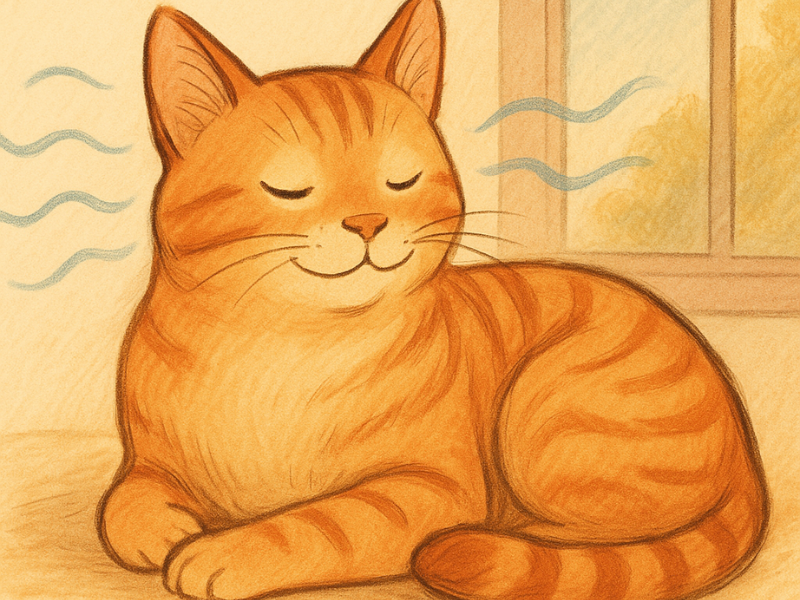
When Minursi settles onto his favorite blanket and starts purring with his eyes half-closed, everything about him becomes stillness. Sometimes I catch myself breathing at the same rhythm.
A cat’s purr pulls you into its frequency, and before you know it, you’re in something close to a meditative state. Your mind turns the volume down, and all that’s left is the feeling of simply being here.
Animal therapists often call purring “the cat’s breath”: a sonic form of inner balance. Maybe that’s why it’s so contagious.
What Purring Is Not: Myths and Misconceptions
Like anything fascinating, purring comes with its share of myths. Some are harmless, others a little confusing. Let’s clear up the most common ones without losing the magic.
“Cats only purr when they’re happy.”
This is the classic one. Purring often does express contentment, but not always. Cats also purr when they’re in pain, scared, or sad, as a form of self-comfort or as a way of asking for help.
In fact, vets learn to spot those differences. A fast, irregular, or forced purr can be a sign of discomfort.
Minursi, for example, sounds completely different when he’s relaxed versus when he’s nervous. You don’t need to be an expert; you just need to pay attention.
“Cats purr to manipulate us.”
Okay, there’s a grain of truth there, but not in a bad way. They’ve learned to use purring to communicate with us, and if they know that sound triggers our soft side, of course they use it.
But “manipulate” is too cold a word for something this beautiful. I prefer to think of it as them teaching us to listen better.
“Purring cures all diseases.”
If only it were that simple.
Purring has real positive effects, but it doesn’t replace medical treatment. What it does is comfort, relieve, and in many cases, complement. There’s something deeply therapeutic about that contact, and even if it’s not a medical cure, it’s still a form of healing.
Purring as an Emotional Mirror
Living with a cat forces you to sharpen your sensitivity. You learn to read gestures, tones, silences. Purring is one of the most subtle signals out there.
Every cat has their own style: some purr loudly, others almost silently. Some do it all the time; others save it for very specific moments.
What’s interesting is that the more connected you are with your cat, the better you understand which purr means what. It’s like their vibration becomes a shared language, one that bypasses words but feels just as clear.
Minursi, for instance, has a special purr he only uses when I scratch behind his ears. It’s deeper, slower, and every time I hear it, I know we’re on the same wavelength.
Historical Curiosities About Cat Purring
Throughout history, purring has fascinated humans across every culture. In Ancient Egypt, cats were believed to be connected to the divine, and their purring was thought to have protective powers. Some ancient texts described them as “the guardians of silence.”
During the Middle Ages, things took a darker turn. There were periods when the sound of purring was linked to witchcraft, as if it were a magical vibration communicating with other worlds. Sad, but also revealing: even human fear acknowledged there was something special about that sound.
In Japan, purring was seen as a symbol of luck and harmony. The Maneki-neko (the cat with the waving paw) represents the positive, calming energy of purring: drawing in the good, keeping the bad away.
In Scotland, there was a belief that if a cat purred next to a sick person, they’d recover faster. The curious part is that modern science is starting to confirm that old folk wisdom had something to it.
The Future of Science: What We Still Don’t Know About Cat Purring
Hard as it is to believe, there are still things we don’t fully understand about purring.
We know how they do it and when, but not always why.
One of the most intriguing open questions is whether cats are aware of the effect their purring has on us. Do they know they’re calming us down? Or do they just do it for their own well-being, and we happen to benefit?
Some scientists, like Karen McComb at the University of Sussex, believe there’s an intentional element. They think cats have adapted their purr to life with humans, creating a form of communication that benefits both sides.
Others think there’s no intention involved, just evolution: cats that communicated better and formed stronger bonds had better chances of surviving and reproducing. Either way, the outcome is the same. Purring has become a one-of-a-kind form of cross-species connection.
Cat Purring Beyond Medicine
In veterinary medicine, researchers are exploring the potential of purring to inspire vibration-based therapies. The idea is straightforward: if the frequencies of purring promote bone regeneration, why not use similar sounds in physical therapy or rehabilitation?
There are already experimental devices that mimic purring frequencies to relieve muscle pain. They’re not the same as having a real cat in your arms, but the results are promising.
Who knows? Maybe one day there will be clinics offering “therapeutic feline vibration” as a natural treatment.
Purring and Feline Personality
One of the most interesting things is how purring reflects each cat’s personality. Some cats are subtle, barely audible, while others sound like a little motor running day and night.
The more social ones tend to purr often, while the more reserved cats save it for very specific moments. But there’s no fixed rule. Every cat creates their own language of vibrations.
Minursi, for example, has his own repertoire:
- A long, deep purr when he’s sleeping.
- A short, higher-pitched one when he wants attention.
- A quiet, almost imperceptible one when he’s just relaxed, watching the world.
Sometimes I hear him purring while he stares out the window. Nobody else is around. No outside stimulation. Just him and his inner world. I think that’s his zen moment.
Purring and Grief: When the Silence Hits Hard
Not every moment with a cat is easy, and purring is present in the hard ones too.
Anyone who’s been with a cat in their final days knows that sometimes they purr right until the end.
For a long time, people thought that was a sign of peace. Today we know it can also be a way of soothing themselves and their human. In that context, the purr becomes a silent bridge of love, a way of saying “I’m here, it’s okay.”
It’s hard to write about without getting emotional, because purring isn’t just a sound: it’s presence. Even after it’s gone, it feels like part of it lingers in the house.
Frequently Asked Questions About Cat Purring
Why does my cat purr when I pet him?
Because he feels comfortable and safe. Physical contact and the sound of a human voice stimulate the parasympathetic nervous system, which triggers a purr of pleasure and connection.
Why does my cat purr when he’s sick or injured?
Purring helps release endorphins, which reduce pain and stress. It can also have a real physiological effect on wound healing and tissue regeneration.
Does my cat purr to communicate with me?
Yes, especially if he’s lived with you since he was young. Some cats use different tones and frequencies to ask for food, attention, or simply to say hello.
Can I record purring and use it to relax?
Absolutely. In fact, studies show that listening to recorded purring can induce a state of calm and improve concentration. But nothing compares to the real thing, purring live on your lap.
Why do some cats barely purr?
Every cat is different. Some have very soft purrs or only use them at very specific times. It doesn’t mean they’re any less happy; they just express it differently.
Can purring have negative effects?
No. At most, if a cat purrs constantly while showing signs of discomfort (lethargy, rapid breathing, loss of appetite), it could point to pain or anxiety. In that case, it’s worth checking in with the vet.
Cat Purring as a Bridge Between Species
At its core, purring is more than a biological curiosity. It’s a form of communication that crosses barriers.
When a cat purrs next to you, you don’t need to understand the language: the message gets through. It’s calm, trust, presence. It’s saying without words: “Right here, with you, I’m safe.”
Somehow, we respond the same way, slowing down, smiling without realizing it.
Maybe that’s why cats and humans have been walking together for so many centuries, each learning from the other, sharing vibrations that don’t need translation.
Minursi tends to do it at the most unexpected moments. When I close my laptop, when I turn off the lights, when I sit down in silence. Sometimes I think he doesn’t purr out of habit but out of choice. As if he knows that sound has the power to bring me back to the present.
The Purr That Heals from Within
Purring is one of those small wonders that blends science and magic without contradiction.
A natural, gentle, steady tool that balances, accompanies, and heals.
Humans have words. Cats have vibrations. In the end, we’re both talking about the same thing: the need for calm, affection, and connection.
Maybe we’ll never know all the secrets of purring, but we don’t need to. Sometimes the most beautiful thing about something isn’t understanding it completely but feeling it.
When the day ends and Minursi curls up beside me, filling the room with that quiet hum, I understand why cats never need to say anything more. They’re already saying everything.
Want to hear Minursi? Check out his YouTube channel!
The Silence After the Purr
When the purring stops, a different kind of silence takes over. It’s not empty; it’s calm. As if the vibration is still floating in the air, reminding you that well-being can be simple: a blanket, a steady breath, and the sound of someone who trusts you.
Getting your home ready, taking care of your cat, listening to their purr: in the end, it’s all part of the same thing. Taking care of each other. In that small daily lesson, cats remain our best teachers.
Does your cat have a special purr too? Tell me about it in the comments: when they do it, what it sounds like, how it makes you feel. Every story is different, but they all share that same vibration of feline love.