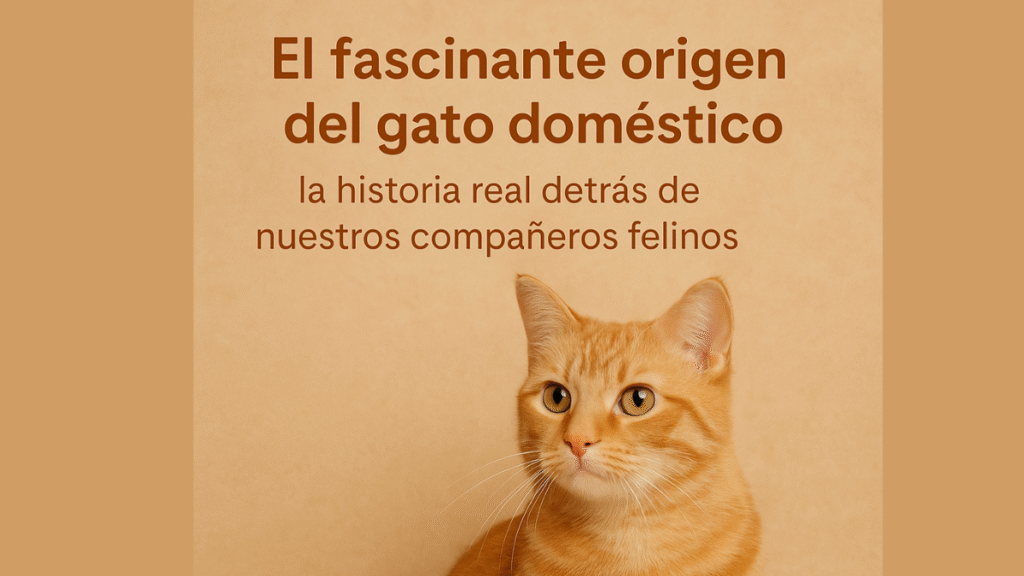

Find out why cats smell so good, what science says about their natural scent, how their grooming habits work, and why their smell is so comforting to us. A perfect blend of biology, behavior, and feline emotion.
Sometimes, when I’m relaxing on the couch and Minursi curls up beside me, I catch myself pressing my nose against his head without even thinking about it. It’s automatic, almost unconscious, like I’m reaching for that scent of his that just makes everything feel okay. It’s warm, soft, clean, and somehow familiar. I don’t know if you do this too, but there’s something about the way a cat smells that wraps around you in a way nothing else can. It’s a scent that doesn’t overwhelm. It just stays with you.
It’s always amazed me that cats smell so good. Even after they’ve been getting into trouble, running around playing, or just waking up from a deep nap, they still smell like home. Like peace. Like calm. A scent so clean it seems impossible they’re not doing anything special to pull it off. But they are. It’s built into their skin, their fur, and the way they are.
Science has answers, sure, but there’s an emotional side to it too. A cat doesn’t smell good just because of biology. Their scent is layered with bonds, memories, and feelings that mix with our own affection. Over the years, I’ve come to realize that scent is part of the silent language we share with them.
As I write this, Minursi walks over, stretches, and looks at me like he knows exactly what I’m talking about. He sits down with that classic feline elegance, “allows” me to smell his head (according to him, it’s a courtesy gesture), and then lets out a soft little “mrrr,” as if he wants to add his two cents to this post.
Built by Evolution to Smell Good
The first thing I learned when I started looking into this is that a cat’s scent isn’t a fluke. It’s not cosmetic and it’s not some random quirk of nature. Cats smell good because their survival depended on it for thousands of years.
In the wild, any strong smell can attract predators or tip off prey. A feline that gave off a noticeable scent would be at a constant disadvantage. That’s why evolution favored the cleanest, most neutral-smelling cats.
What’s incredible is that this “neutrality” turned into something more over time. It’s not just the absence of bad smell; it’s the presence of an extremely delicate, barely-there scent that just happens to be really pleasant.
Minursi, who knows nothing about evolutionary biology but plenty about looking good, is currently washing a paw with the focus of a surgeon. I think there’s some feline vanity at play on top of the instinct, they know they smell good. They love it.
Felines That Don’t Give Themselves Away
Unlike other animals (like dogs, who have a much stronger smell for completely different reasons), domestic cats have fur that holds almost no odor. Their skin produces very clean oils, and the way they move means they don’t sweat nearly as much as other species.
Cats don’t smell like “animal.” They don’t smell like damp, or effort, or skin. They smell like… cat. A soft, slightly warm scent that reminds you a little of sunshine, a little of their favorite blanket, and a little of nothing at all. It’s like their smell is a whisper.
Back in ancient times, that whisper kept them alive.
The Biology Behind the Feline Scent
Cats have a unique advantage: they produce very little body odor. They don’t have sweat glands covering their whole body like we do. The few glands they have are concentrated in very specific areas:
- Around the muzzle.
- Between the paw pads.
- At the base of the tail.
- Behind the ears.
The interesting thing is that these glands don’t produce an unpleasant smell. Just the opposite: their purpose is social, affectionate, communicative. Cats use them to mark, to greet, to form bonds. They do it through a scent that, for us, usually comes across as… wonderful.
The Natural Oils in Their Fur
Cat fur produces oils that don’t smell bad at all. They actually work as a protective layer that repels dirt and moisture, and they give off that soft scent you notice when you press your nose to the top of their head.
Every time I scratch Minursi behind the ears, I pick up that warm, almost creamy smell. There’s something deeply comforting about it, like that scent is part of what makes a house feel like home. Sometimes I close my eyes and just breathe it in. It’s the kind of smell that makes your whole body downshift.
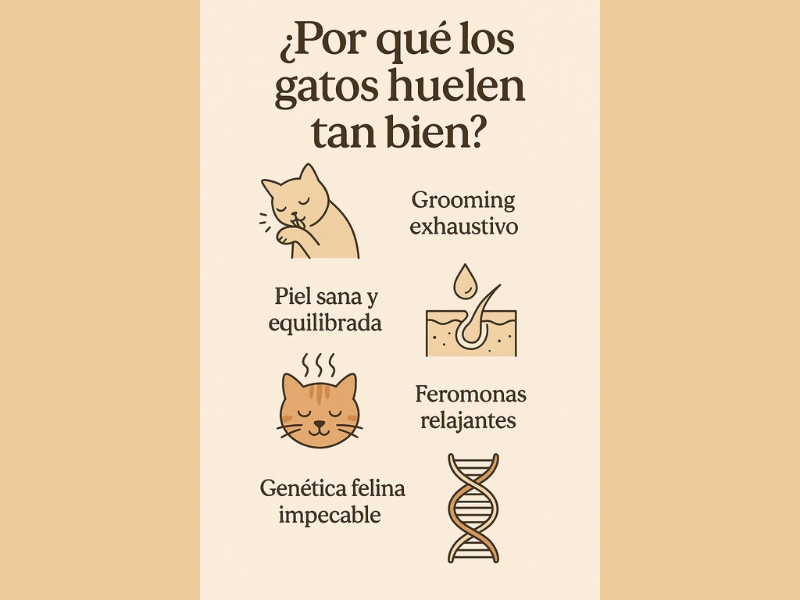
Science explains that these oils have an especially clean chemical composition. They don’t oxidize quickly, they don’t trap odor-causing bacteria, and they get spread all over the body through grooming. That’s why cats smell so good.
When a cat grooms, they really mean it.
The Art of Grooming: Feline Perfection
Cats spend between 30 and 50 percent of their day grooming. That’s not an exaggeration; it’s their natural way of staying healthy, emotionally balanced, and, of course, spotless.
Minursi can be completely knocked out, wake up, yawn, and immediately launch into his cleaning routine. He takes his time, with a level of dedication I wish I had for my own self-care habits.
The Tongue That Does It All
A cat’s tongue is an evolutionary masterpiece. It’s covered in tiny hook-shaped papillae that work like a professional brush. These hooks drag away dirt, dead skin, dust, and spread the fur’s natural oils across the entire body.
It’s like they give themselves a full bath without water, using nothing but precision and patience. When a cat grooms, it’s not “removing odors.” It’s resetting, bringing its coat back to its natural state, which is clean and soft. The result is that nearly neutral scent we love so much.
Minursi, meanwhile, is still at it. He glanced at me for a second and made a little approving sound, like he endorses what I’m writing. According to him, this is all his doing. I’m just the secretary.
Why We Find the Way Cats Smell So Comforting
What stands out to me most is that a cat’s scent isn’t just pleasant; it’s emotionally comforting. There’s something about that warm, soft aroma that slows you down, calms you, and gives you a feeling of home.
Emotion plays the main role here, but science has something to say too.
We humans associate certain smells with safety, cleanliness, and well-being. The unique blend of a cat’s fur, surprisingly, lines up with a lot of those feelings. A cat smells like calm, and our brain responds accordingly.
When I press my nose to Minursi’s head and breathe him in (it’s part of our daily ritual at this point), I feel a kind of mental pause. It’s as if, for a moment, my body understands there’s nothing urgent, that everything’s fine. The interesting part is that he stays perfectly still, as if he knows the gesture matters to me.
The Scent of Attachment
Studies show that our brain processes smells associated with loved ones differently. It analyzes them less and accepts them faster. These are scents we don’t “review”; we recognize them as our own.
The same thing happens with cats when we’ve lived with them long enough. Minursi’s scent isn’t just the smell “of a cat.” It’s the smell of my cat.
Pheromones: The Invisible Perfume We Don’t Know We’re Smelling
Another reason cats smell so good to us is their facial pheromones, chemical substances they use to signal safety, trust, and affection.
When a cat rubs its head against you, bumps you with its forehead, or leaves its scent on an object, it’s depositing pheromones. We can’t consciously smell them, but our brain still reacts. It’s interesting how these pheromones work. For the cat, they represent:
- Calm.
- Familiarity.
- Bonding.
- Emotional stability.
Even though we don’t pick them up directly, we’re responding to that invisible message. It’s like your cat is telling you without words: “You’re home. Everything’s okay.”
When Minursi rubs his forehead against me or bumps me with his head, I always read it as affection. It is, but he’s also marking both of us with that “perfume” we can’t smell but definitely feel.
Why Cats Smell So Good Right Behind the Ears
One of the best-smelling spots on a cat is right behind the ears. It’s a warm, soft, delicate, almost creamy scent. That area has a high concentration of clean natural oils and social pheromones.
I don’t know about you, but I always end up sniffing Minursi’s little head right there. It’s my favorite spot. He sometimes makes a quiet little noise, like he’s saying “yes, yes, I know you love it.”
Every Cat Has Their Own Scent
Even though all cats share that quality of smelling good, each one has a different scent. It’s subtle, but it’s there.
Some cats smell sweeter, others more neutral, others more like a warm blanket fresh out of the dryer. That scent also shifts based on:
- Their diet.
- Their stress level.
- Their age.
- Their coat type.
- Their environment.
- Their grooming routine.
Sometimes, after Minursi has been sleeping in his favorite spot on that blanket that seems to have magical powers, he smells exactly like “his nap.” It’s hard to explain, but it’s a smell I associate with peace.
A Scent That Also Tells You About Their Health
What’s fascinating is that a cat’s smell says a lot about their well-being. A healthy cat smells good naturally. When a cat starts smelling different (stronger, off, or oddly like nothing), it’s usually a sign something’s not right. It could be:
- Stress.
- A dental issue.
- Hormonal problems.
- Skin infections.
- A change in diet.
That’s why one way to look out for your cat is to get familiar with their usual scent. With Minursi, for example, his smell is so distinctly his that if it ever changed, I’d notice right away. It’s something you pick up on without trying when you live with a cat day after day.
Scent as Part of the Human-Cat Bond
One of the things that fascinates me most is how scent is part of the bond we build with our cats. It’s not just something that smells nice; it’s part of attachment, communication, and shared emotional well-being.
When a cat sleeps on you, rubs against you, marks you, or simply lies next to you, it’s creating a web of scents that defines your shared space. A kind of “emotional territory” you both belong to.
That might sound poetic, but science confirms that cats choose who to mark for emotional reasons. Minursi, for example, marks my face constantly. Every time I come home from work, he rubs against me, sniffs me, and then “signs” me with his scent. According to him, it’s a gesture of love… and also of private property.
Your Cat Thinks You Smell Good Too
Here’s the sweet part: just like we love the way cats smell, they love the way we smell. In fact, they recognize us more by scent than by sight.
When Minursi sits on top of my freshly folded laundry, he’s not “ruining” it (well, maybe a little). He’s looking for my scent. He’s reinforcing the bond. So at the end of the day, his scent and ours blend together. That’s where that little domestic universe we share takes shape.
Myths About Why Cats Smell So Good
There are a lot of myths around the way cats smell, and it’s worth clearing them up because some lead to pretty silly misunderstandings.
“Cats don’t smell because they bathe themselves.”
Not exactly. Cats don’t bathe; they groom. They don’t use water to get rid of odors. They use their tongue, their natural oils, and their social behavior.
An actual bath is helpful in very specific cases, but it’s not part of their natural biology.
“A clean cat doesn’t need to go to the vet.”
Just the opposite. A change in their scent is often an important health warning. Smelling good doesn’t mean nothing could be going on internally.
“Cats smell strong if they live in apartments.”
No. What smells strong is a poorly maintained environment, not the cat. A healthy, well-fed cat with a clean litter box always smells good, no matter where they live.
Minursi has just flopped down next to me, as if he wants to make something clear: “I always smell good. The problem is your litter box if you don’t clean it.”
He’s right, though he could be a little more diplomatic about it.
How to Preserve That Natural, Amazing Scent
One of the questions I get asked most is whether we can “help” our cats keep smelling great. The answer is yes, but not the way most people think. A cat’s scent is natural. You don’t create it; you protect it.
The key is less about stepping in and more about respecting and supporting their own biology.
Diet: Where Every Good Scent Starts
What a cat eats has a huge impact on how they smell. Skin and fur are nourished from the inside out. A balanced diet with quality protein and few artificial ingredients means:
- Cleaner oil production.
- Healthier skin.
- Shinier coat.
- A more consistent natural scent.
When I switched Minursi to a higher-quality food, his scent got even softer. It’s a subtle difference, but you notice it when you’re around them every day.
Minursi, who’s currently trying to dip his paw into my water glass, seems to agree. According to him, everything good starts with food.
Brushing: A Helping Hand They Actually Appreciate
Cats groom themselves, sure, but regular brushing is one of the best ways to boost their natural scent. Brushing removes:
- Dust.
- Dead skin.
- Loose fur.
- Environmental residue.
It also distributes their natural oils more evenly. It’s like combing the scent through their fur. Minursi has his favorite brush. When I pull it out, he comes running and plants himself in front of me like a feline model ready for a beauty session. I laugh, but he takes it very seriously.
A Clean Home, a Good-Smelling Cat
A clean environment keeps a cat’s scent pure. The rugs, blankets, cushions, and beds they use should be washed with gentle products, free of strong artificial fragrances that could throw off their natural smell.
One interesting tip:
Don’t wash your cat’s favorite blanket too often, because part of their social scent lives there. Wash it when it needs it, not out of habit.
Skip the Perfume and Sprays
Cats don’t need perfume. Their natural scent is already perfect. On top of that, their skin is much more sensitive than ours, and any scented product can irritate it or interfere with their pheromones.
If you want your house to smell nice, work on the space, not the cat. A cat’s scent shouldn’t be covered up.
Do All Cats Smell the Same? No, and That’s the Magic.
Even though they share a general type of pleasant scent, every cat smells different. That “personal” aroma comes from a surprising mix of biological and environmental factors.
Age Makes a Big Difference
Kittens tend to smell sweeter, more milky, more like the nest.
Adults have a more stable, warm, and soft scent.
Older cats sometimes smell a little different: calmer, less oily.
Minursi, in the prime of his adult life, smells like a warm blanket, a long nap, and winter sunshine. I know that sounds cheesy, but it’s true.
Coat Type Affects Their Scent Too
- Shorthaired cats tend to smell slightly stronger (within the realm of subtle).
- Longhaired cats have a more “airy” scent.
- Dense coats hold warmth and scent better.
Stress Can Change Their Scent
A stressed cat produces different natural oils, which can change their smell. Never bad, but noticeably different. After a vet visit, for example, their “social scent” shifts, and other cats in the house might not recognize them right away.
Minursi, every time he gets back from the vet (thoroughly offended, naturally), smells what I call “like outside.” He protests, claiming that’s a human exaggeration.
Why a Cat’s Scent Really Does Calm Us (The Neuroscience)
Beyond the emotional associations, there are real reasons why a cat’s smell triggers a sense of well-being. Our brain processes scent through the limbic system, the same area responsible for emotions and memory. When we smell something we recognize as safe, our body:
- Lowers cortisol.
- Releases serotonin.
- Steadies breathing.
- Slows the heart rate.
That’s why a cat’s scent becomes a kind of “emotional anchor.” It brings you back to the present and softens your day. It’s like cats come equipped with a quiet little calm mechanism they share with us without a sound.
Minursi, who is currently half-asleep on the keyboard, is giving off that warm, barely-there scent that makes writing about him even easier.
Frequently Asked Questions About Why Cats Smell So Good
Why does my cat smell so good even after sleeping for hours?
Because warmth activates their natural oils, which smell even softer when the cat is relaxed and content.
Is it normal for some cats to smell sweeter?
Yes. It depends on their genetics, their diet, and their pheromones. Every cat has their own personal “perfume.”
What does it mean if my cat suddenly smells different?
It could be stress, a dental issue, a skin infection, or a change in diet. If the change is strong or sudden, it’s worth checking in with the vet.
Why do cats smell so good right behind the ears?
That area is rich in clean natural oils and social pheromones. That’s why it always gives off that irresistible scent.
Do cats know they smell good?
Probably not the way we think of it, but they are aware of their own scent and know it’s a tool for social interaction and communication.
Why don’t dogs smell like this?
Because their biology is different: they have more sweat glands, different oils, and less consistent grooming habits.
Scent as a Silent Message of Love
After everything I’ve read, researched, and lived through with Minursi, I’ve come to the conclusion that a cat’s scent isn’t just biology. It’s connection.
It’s a blend of oils, pheromones, warmth, trust, and shared life. It’s the scent of someone who chose to share their space with you. It’s the smell of their calm, which becomes yours too.
Sometimes I think sniffing a cat is a form of communication that we humans don’t fully understand, but feel deeply.
Minursi has just settled next to me, like he knows I’m wrapping this up. He looks at me, slow-blinks, and pushes his head my way. I sniff him, of course. I smile.
He smells like “us,” too.